Lesson 2
I keep telling people this and I keep not doing it but one of these days I need to read Simulacra and Simulation for real. But you’re not here to talk about my fetishes, let’s talk about Heathcliff:
There’s something interesting about the concept of identity and the way that humans process it, right? in a first-person perspective, we have this feeling of one continuous coherent identity but that’s not really true. We are constantly performing. We change our performance to suit the situation and different environmental factors change the way we approach our performance. That’s not to say we are lying or that we are consciously making these choices but it’s true. Even a performance is real, can be true.
Very common in therapy is the process of trying to understand yourself and evaluate your own actions in comparison to your beliefs. To have the ways that your performance is mismatched to your intentions analyzed and so you can build a pattern to recognize these things and adjust your performance accordingly. We see Heathcliff literally puppeting himself in therapy. He has developed enough of a grasp over his own inner workings that he can convincingly portray his character as a literal acting performance. He is in command of himself.
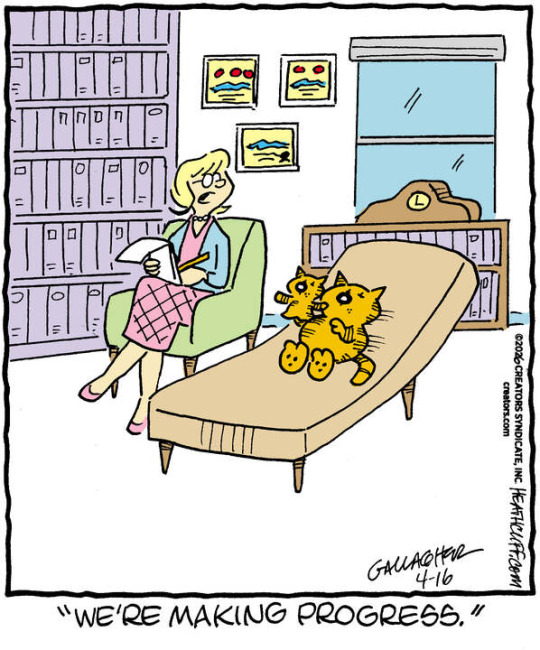
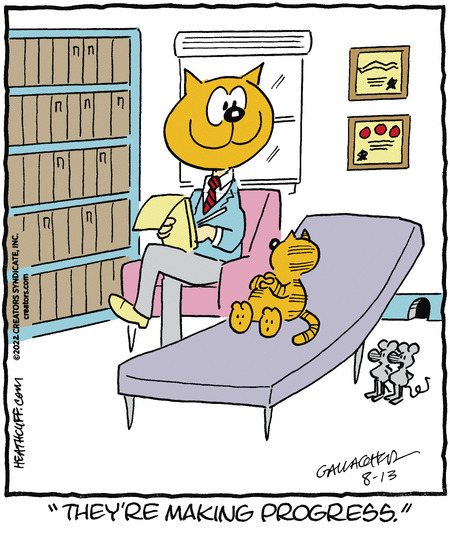
In the process of preparing this edition of Heathcliff Semiotics, I discovered that there are like 80 therapy comics in the Heathcliff Oeuvre. I specifically want to look at the ones where progress is being made and we are seeing that symbol of The Self, Abstracted:
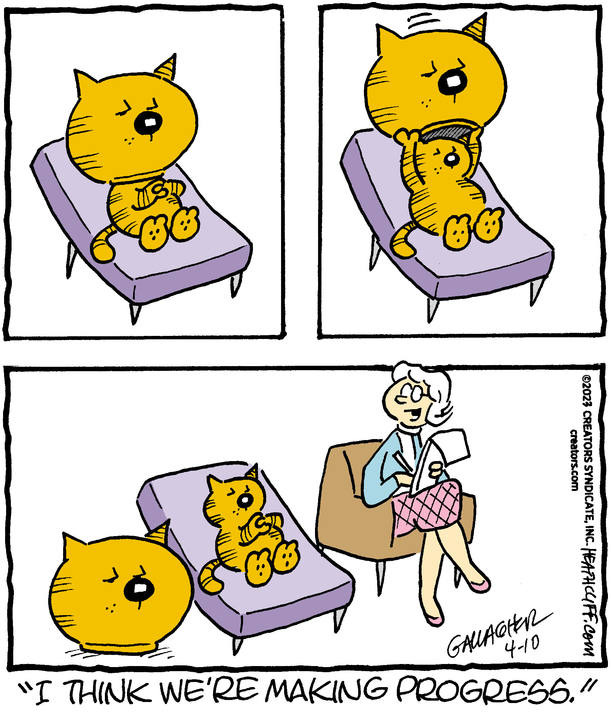
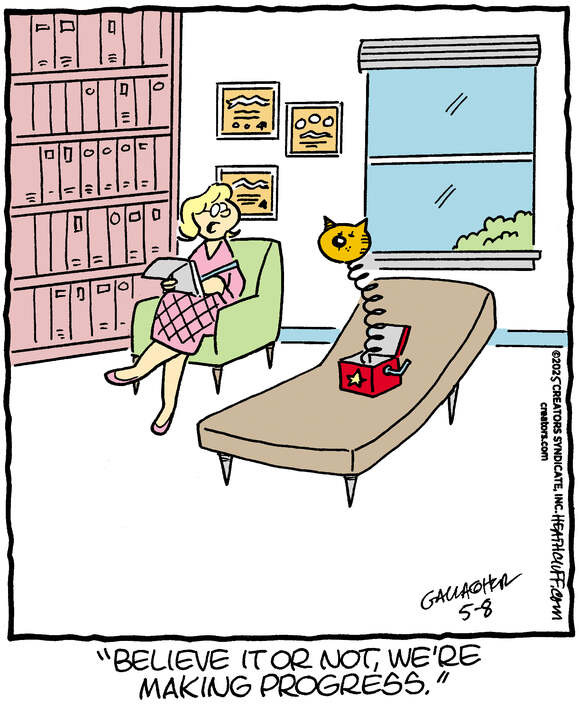
All of the imagery around masks (even a jack in the box is a “face on a spring”) holds: Therapists will often repeat what the patient has said so the patient can see how others perceive them. Heathcliff takes off his mask to find that his performance IS who he is. Heathcliff has developed an abstraction of his body which helps him understand what makes him tick and pop. (one thing past me did get right is that he has developed a neutral response to his body having a meltdown. shame is a constructed experience)
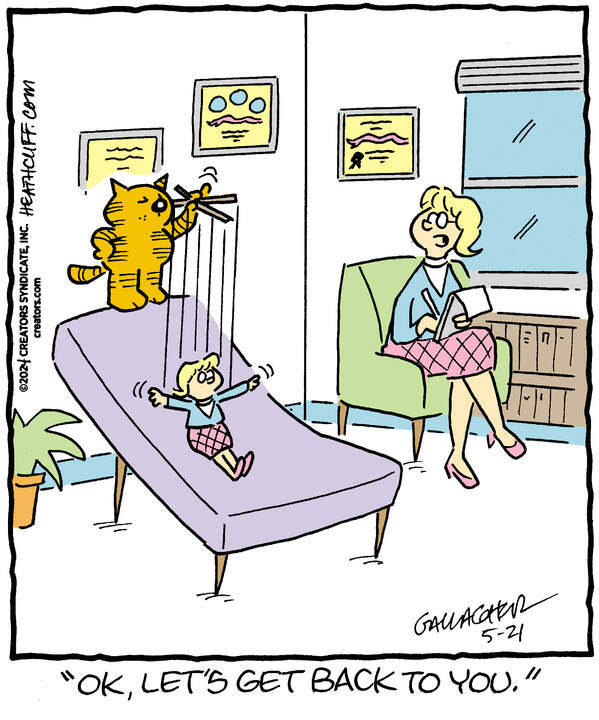
I really like this as a positive interaction. It’s easy to read her saying “Ok, let’s get back to you” as impatient or offended but I don’t think that’s the case. they’ve been working on simulacra and simulation, Heathcliff has stumbled into the realization that if everything is a performance so is therapy, so is what the therapist is doing. look at how I understand the performance of the therapist. And she is responding, “correct. You are understanding the situation. now let’s apply it to the Self.” a good therapist directs the patient similarly to a good nanny: acknowledge positive progress, allow the patient to lead in the interactions, provide gentle pressure towards a progressing path through the interactions.
BUT ENOUGH ABOUT THE BOOOOORRRING SHITT, THIS IS NEWSPAPER COMICS
CECI N'EST PAS UNE PIPE MOTHERFUCKERRRRRlet’s look at that multi-panel comic again. something I think is absolutely fascinating is Heathcliff gradually taking off his mask and embodying himself instead of merely a perception of himself. It also just so happens this comic has the therapist bleeding outside of the border line. She is reaching through the structures and imagined boundaries and saying “good work recognizing that. It is only the beginning” she’s not actually reaching through any of this because she’s just lines on a page. They aren’t even in an office or a location at all, it’s just white space. taking off the mask and embodying oneself is just the beginning, you have the entire medium through which your performance is happening to understand and explore. And even still you have to continue embodying your beliefs and ideals through all that. also, Heathcliff did not take off a mask because there is no mask, there is no spoon. A therapist is not talking to Heathcliff at all. all of these symbols are being directed at us to communicate to us the readers of the comic.
The only reason I think this woman is a therapist is that there are symbols that resemble diplomas and certifications and licenses on the wall. That she sits on a chair by a couch Freud-Jungianly. This is just Gallagher doodles. This is what I mean by all this shit. It doesn’t matter what Gallagher himself is intending because the symbols he’s pulling on are so potent that they create an entire therapist and context around therapy in my mind. Who is paying for their cat to talk to a cognitive behavioral therapist? What is heathcliff’s problem that they are making progress on? What actually is progress? What are the ethics of cat therapy? If cats are sentient enough to benefit from cognitive therapy, what does that mean about other animals and also the state of animal rights? What is actually on those licenses and diplomas in the background, what is her degree in? none of this comes to your mind first. No, when you look at the image, You see a therapist with her patient and you understand that Heathcliff puppeting himself is a working therapeutic endeavor. Gallagher is able to do this because he does have a pretty solid control over this kind of symbology even if it is intuitive. He’s really good at making the panel immediately say something as soon as your eyes land on it, before you consciously grab hold with your cognitive hands, (“)really grab the impression of something so that you don’t ask too many questions (” she says, completely forgetting that the average comics enjoyer looks at heathcliff and asks “What?”) I fucking love cartoons, dude.