
Hulagirl.txt
Have you seen this woman?

Perhaps enough time has passed that she is merely an inconsequential sighting to the average webuser, a rarity of a signal overlooked in the noise. There was once a time that she danced her way across webpages all over geocities and brought a small injection of joy and energy to whatever page she graced. Early on, she was a known quantity but the passage of time and memory made her mysterious. Stayed mysterious for a long while since, honestly, who really cares about the provenance of a free-to-use gif that is barely 5kB?
Olia Lialina is one such person. An artist, archivist, and connoisseur of everything digital, Lialina recalls first encountering Hulagirl in 1998 where she utilized her for the landing page for rhizome.org (where you can still see her twisting away between trails of copyright logos). Lialina imprinted upon this little dancing figure and decided to herself become a model for animated gifs.
Click here for some samples of her work that you might also have encountered if you've been around the net long enough.




It wasn't until 2009 that the wheels of Hulagirl research started really turning. Yahoo announced the closure of its free-to-use website platform Geocities which triggered a response from The Internet Archive to scrape as much data as they possibly could to rescue the information contained in this digital Library of Alexandria. It was this archive that Lialina and her colleague Dragan Espenschied started exploring for their project at The Geocities Institute Blog: One Terabyte of Kilobyte Age. Jumping two years ahead, on March 21st, 2011 the two internet anthropologists uncovered something new. On a website that collected animated gifs (GifWelt), there was a Hulagirl that still had an author listed in the metadata: Chuck Poynter.
Let's take a step backward.
[insert some iconic chuck gifs]OToKA determined, based on their research, that it's likely Poynter made Hulagirl in September 1996 which gives us an age of 30 for the little dancing lady. As for her debut into the wider web, there was a book published in 1998 called Netscape Communicator (a text for aspiring website creators) which featured a chapter on animated graphics. Right at the top is a screenshot of Poynter's gif collection website and right on the page is none other than Hulagirl. Since this text directly led to her, it only made sense that she would start appearing on more and more personal websites. It also makes sense that Lialina would encounter the dancer the same year Hulagirl was published in a book about webdev.
So that's the answer then. Charles Poynter, retired member of the US Air Force, born in 1937, a man who returned from the war and engaged in his passion of making little animated images. Archive of his collection for your perusal
Well... Let's take another step back.
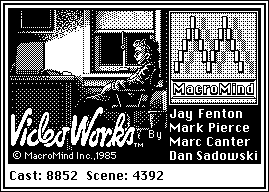
In 1984, a team of developers form the company Macromind and, in 1985, release Macromind VideoWorks. Four names: Marc Canter, Dan Sadowski, Mark Pierce, and Jamie Faye Fenton (that's right! A transgender woman is in this story!). If you dig through the prepackaged demo files, you'll see something interesting: many of Poynter's gifs appear in here.
[insert comparisons]
In particular, on March 30th, 2011 Lialina and Espenschied received a tip that dancing girl appeared in this software and, as you can see, that user was absolutely correct.
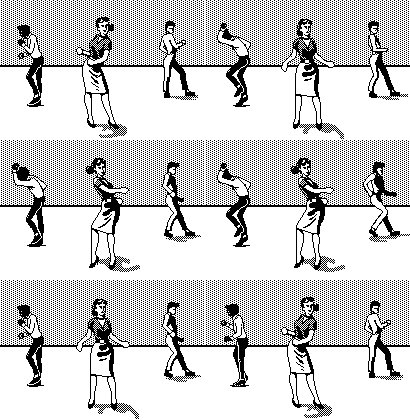
With this monumental discovery, the investigation once again entered stasis. Someone on the Macromind team created Hulagirl as an example piece and it was one of these four names but attempts to get the information were not fruitful until a full six years later on January 3rd, 2017.
A different tumblr user uploaded a gif showing Hulagirl, the one from VideoWorks, doing her thing (as usual). When contacted, ulan-bator directed the team to an archive of old PCX (a graphical format) files that were bundled on the "So Much Shareware" CD-Rom from 1994. It became clear very quickly that these were in fact the source images that Chuck Poynter was using as you will see in the examples under the dropdown here. Hulagirl herself? A spritesheet featuring all the dancers from VideoWorks with a name and date at the bottom. MSP '85. Mark S Pierce of Macromind. This is, in my mind, the surest connection we have to show that Mark Pierce is the original author of this animation.
We have the Father and the Stepfather of Hulagirl locked in. The case is closed.... ....right?
Everything I have shared up to this point has been the research and efforts of the Geocities Institute and followers of the project. Now is where I can step in and share the things that I personally have to contribute to the story.
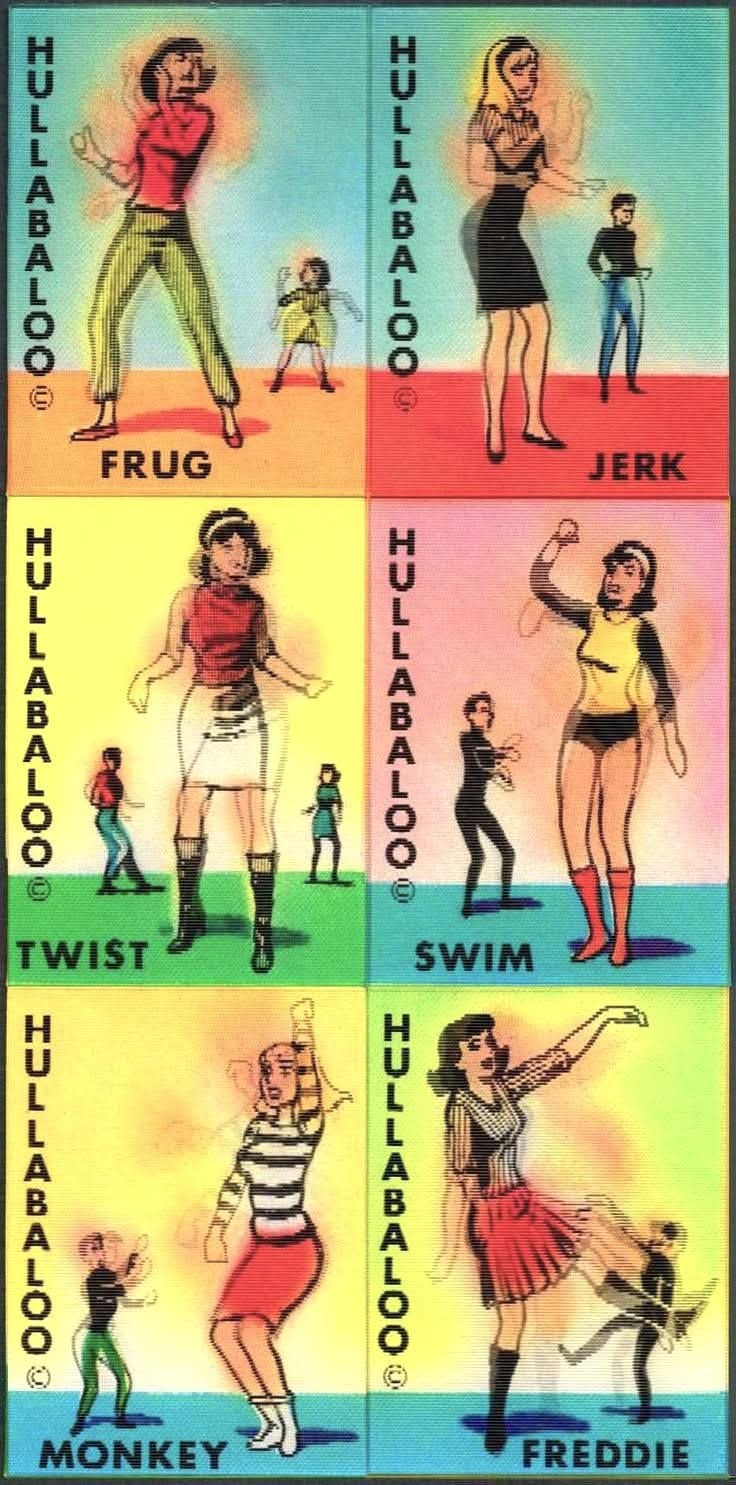
September 7th, 2026, I am browsing the geocities archives on Restorativland and posting about them on tumblr. I scroll down on my dashboard a little bit and see this post from grooveland. Within half a second, I recognize that frame of animation displayed on the one labeled TWIST. I immediately start my research and within a day, I'm already drowning in information.
Perhaps we should take another step back, if you'd be willing to follow me.
So what is this Hullabaloo Twist? It's a "lenticular flicker," a type of image with a lenticular lens affixed to the front which causes different areas of the image to be visible at different angles. This means that successive images along the angle of change can create the illusion of motion. Early versions were used to make static images appear to be three dimensional without the use of special glasses for the viewer. These Auto-Stereo-Graphic images are quite convincing if you have ever seen one in person and sort of hard to capture on camera. Most people have seen these before without knowing anything about the terms Lenticular and Autostereographic (lord knows I didn't until last week). These objects are quite popular as collectors items because there aren't many companies that find them worthwhile to produce anymore. On these flickers, there is information on the back directing the viewer to the Vari-Vue company. Upon exploration, I found that these were commissioned as promotional items for the musical variety television show Hullabaloo wherein popular acts of the day (1965) would perform alongside a group of studio Go-go dancers. The idea is that you'd find one of these little dancer cards and then go watch the show to see if you could spot the dance being performed by the gals on stage. Or, if you watched the show first, get a little commemorative token of your favorite dance. You can see that this card shows the exact same motion as Hulagirl with the same proportions and some of the same dressings. You even have an exact match of one of the background dancers on the card to the Right Guy in the VideoWorks Dance Fever.
This would be the end if not for the fact we still don't have solid physical, documented connections from the 60s to the 80s. So I kept digging. I wanted to see if I could connect Mark Pierce to these cards in some real way.
So lets take one more step back (and I promise this is the last one).
There's a lot to be explored in the history of animation but I want to keep us focused here so you can read more about that nonsense at this link: fidelity's animation guide in progress
In 1908 (What? I did a lot of legwork. Let me be a little indulgent), a physicist named Gabriel Lippmann develops a process he calls integral photography which involves taking an photograph through a special lens constructed like a fly's eye. Then the same kind of lens is affixed to the resulting image to create a strong autostereographic effect. This act of attaching the lens array directly to the image sparks a fever of research that extends into the 20s with Herbert Ives (of half-tone color printing fame) combining the integral idea with a lenticular lens instead of the fly-eye style. By the 1930s, the lenticular lens style was expanded (at least where documentation has been found) in Britain, France, Germany, and the USA.
(Side Note: Remember Chuck Poynter? Born in 1937. A year after the first patent to call the linear lens array "Lenticular." How fun!)
For our purposes, we now focus on one guy: Victor Anderson. (special thanks to Twin Peaks Blog for doing some of this legwork for me already.) In 1948, he returns from the war and engages with his passion: making little animated pictures. Just like Chuck! See, the military had been working with linear camera arrays for their training processes and Anderson brought that knowledge home with him. He founds the company Pictorial Pictures Inc. and starts producing commercial 'flickers', as he calls them. In 1952, he is commissioned by Dwight D. Eisenhower to make a truly icon piece of campaign memorabilia history: The Lenticular "We Like Ike/I like Ike/Win With Ike" button that flickers between the slogan and the man's face. This causes the popularity of the flickers to explode into the public consciousness. This spurs Anderson to file for a patent on his process for assembling the images in 1952. He also reincorporates from Pictorial Pictures to Vari-Vue. After patent approval in 1957, Vari-vue becomes the primary dominating force in the market of lenticular flickers. This is when, in 1965, Hullabaloo shells out for the novelty marketing images of their Go-go dancers.
Let's take a look at the Twist dancer again. Take careful note of her appearance versus that of Hulagirl. See how even her shadow differs from the VideoWorks dancer.

Enter my best friend Chloe who tracked down an eBay listing showing this right here:
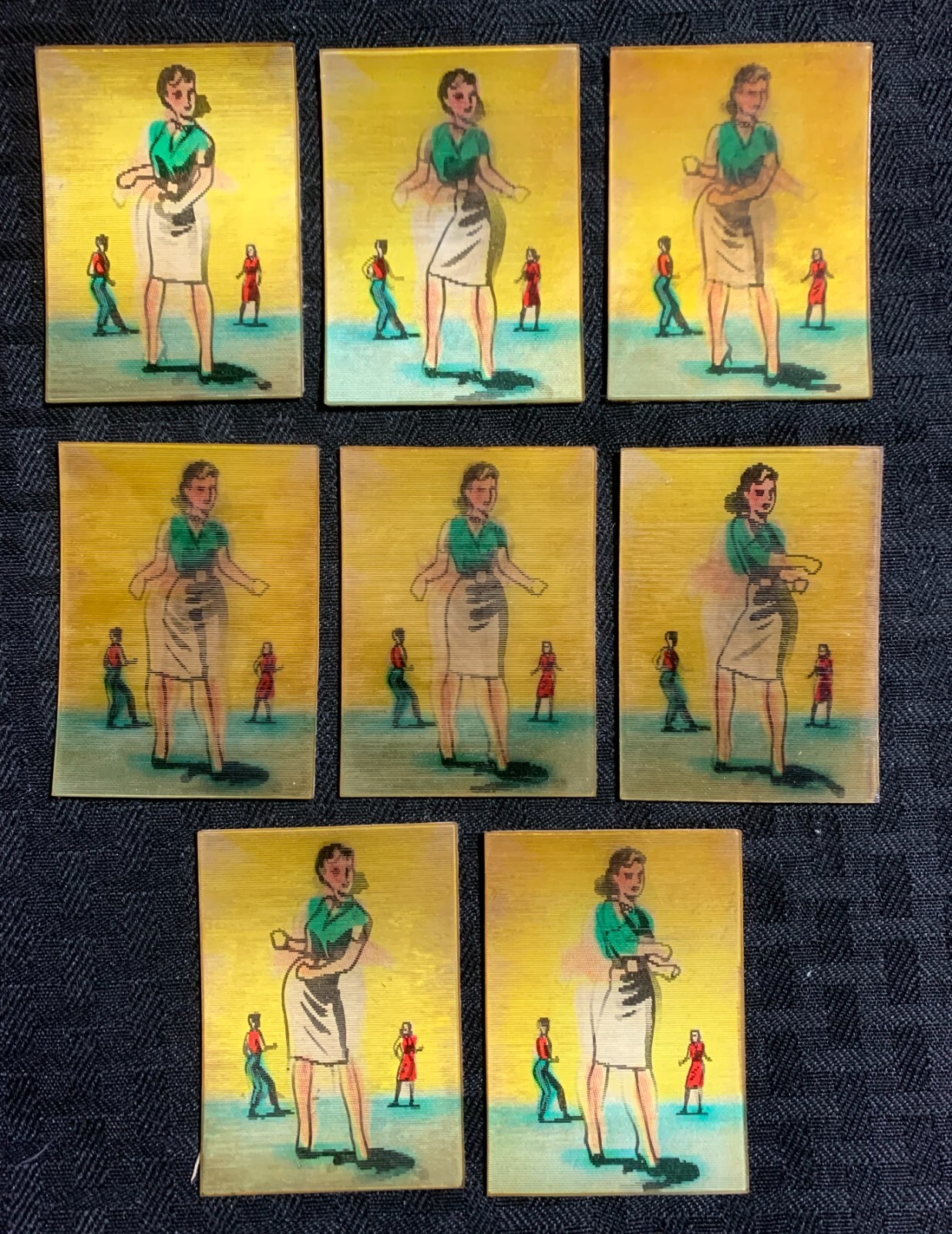
Let's see it overlaid, shall we?
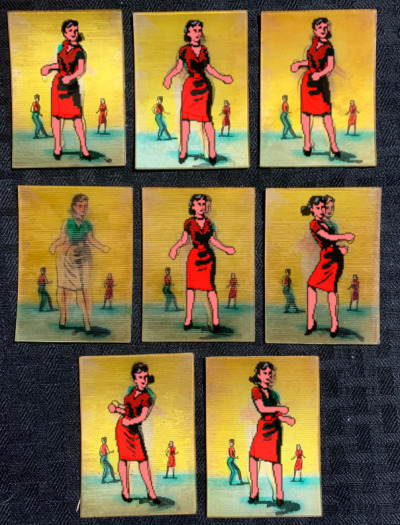
Ladies, that's her. That's Hulagirl. She has the same shirt, the same skirt, the same hair.
On the back of this card, Vari-Vue is credited. This means that she was born sometime between 1953 (reincorporation) and 1965 (Hullabaloo commission). Hulagirl is 61-74 years old and she still looks great and she still got the moves. Grandma has been bringing delight to people for ages!
When I say I was losing my mind, that I was blowing up people's inboxes, when I was literally welling up with tears at this discovery, I mean it. It was so exciting that I was spurred into writing this very document in a mania fueled week and a half of frantic research.
But we aren't through yet!!
I said I wanted to connect this somehow to the fine folks at Macromind, yes? So let's keep pushing, there is more to uncover.
We jump forward 20 years to 1984 and the founding of Macromind. Development starts as Jamie Faye Fenton works on the codebase while Mark Pierce works on the art direction of these demos. Not much of a connection to the lenticular stuff, right? I think I can provide enough information to at least make it believable beyond reasonable doubt (as if the visual comparison wasn't enough). You tell me if it is convincing.
In 1986, Vari-Vue holds an auction to offload their excess stock as they are going under. The company shuts down and all of their cameras and remaining flickers are pawned off to collectors and businessmen. (Ronald Globus Interview: https://www.newyorker.com/magazine/1989/05/08/winky-king \\ Frank Didek purchasing Vari-Vue history: https://twinpeaksblog.com/2020/02/16/twin-peaks-prop-vari-vue-poodle-at-the-johnson-house/ ).
In 1996, the artists at Depthology are interviewed for Glo Magazine (https://web.archive.org/web/20260315055918/http://www.depthography.com/glo.html) where we learn they used some of these collector's collections as inspiration for one of their art installations. In the interview, Robert Munn recounts a moment in 1990 when he was talking to a "computer guy" named Oppenheimer and mentions that some of the collections referenced were also used by the team that developed Macromedia Shockwave. And who exactly is that team? None other than the folks at Macromind, who renamed themselves as their creations gained more traction. After developing their software in 1984 using lenticular references, they of course would carry on the tradition once Vari-vue shuttered and they learned of collectors acquiring the remaining works. So what do you think? Did we finally crack as much information as we can outta this one?
It's unfortunate that we will likely never learn who the artist for the original Hulagirl is unless we can find Vari-Vue's business records somewheres, unless someone finds this particular essay and cares enough to go digging for information after me. That 12 year range on the founding of Vari-Vue and the Hullabaloo commission certainly makes the field more narrow at least! I can only hope someone with more gumption that I have can carry it the rest of the way. Is it not intersting, though, to see how people have been playing with these short and sweet little animations for at least the past 120 years? How the concept of animating artwork as been tumbling around for about 200, maybe even 400 years?
Wellll.... Maybe I lied earlier when I said it was the final time I would take a step backward.
Maaaaybeeee I have one more step, a leap actually. And it isn't 200 years. Or 400 years. Or even 4000 years.
Take my hand one last time as I go back twenty-two thousand years, to paleolithic era France, to the deep recesses of the long, crooked caves where no sunlight reaches at Lascaux. Where humans with naught but firelight, stone, and natural pigments were drawing.
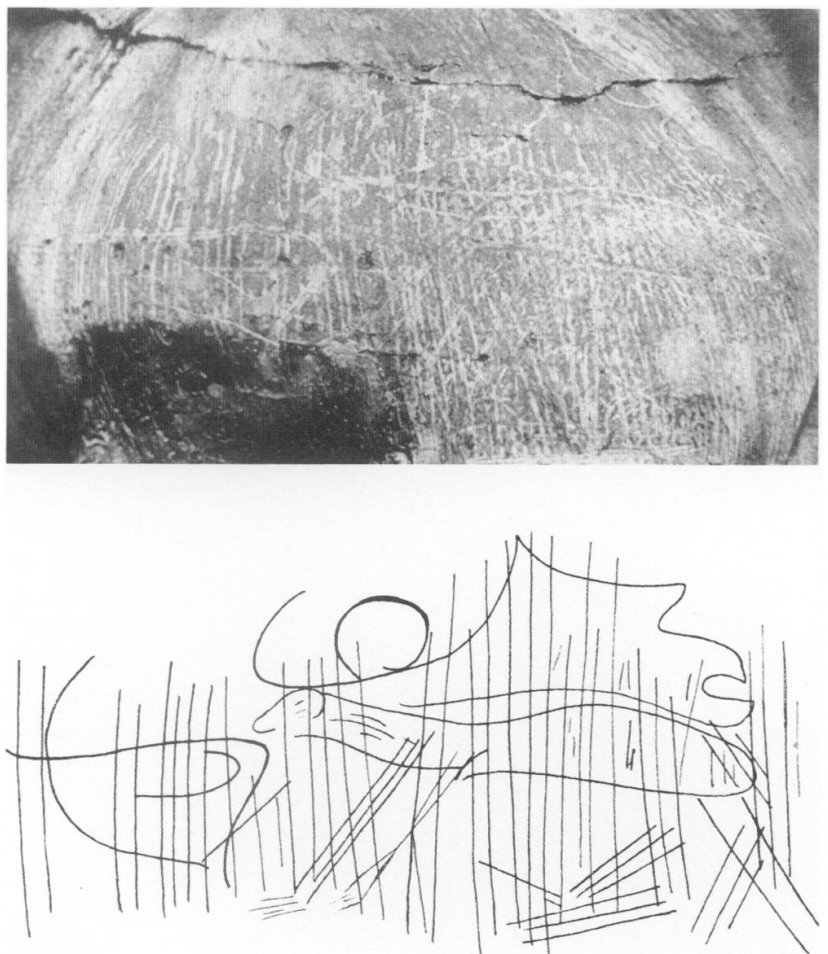
You remember how lenticular optics work. The lines that run perpindicular to the motion of the light source or the viewer. Take note of the lines that divide this image here. For the past few decades, archaeologists and anthropologists have been developing the theory that these odd images were the very first examples of humans creating animations[X][Y]. The firelight dances and causes the images behind those vertical lines to flicker, to catch the light in different ways that cause the subjects raise and lower their heads, to swing their dangerous tusks. To come alive in the light.
~22,000 years.
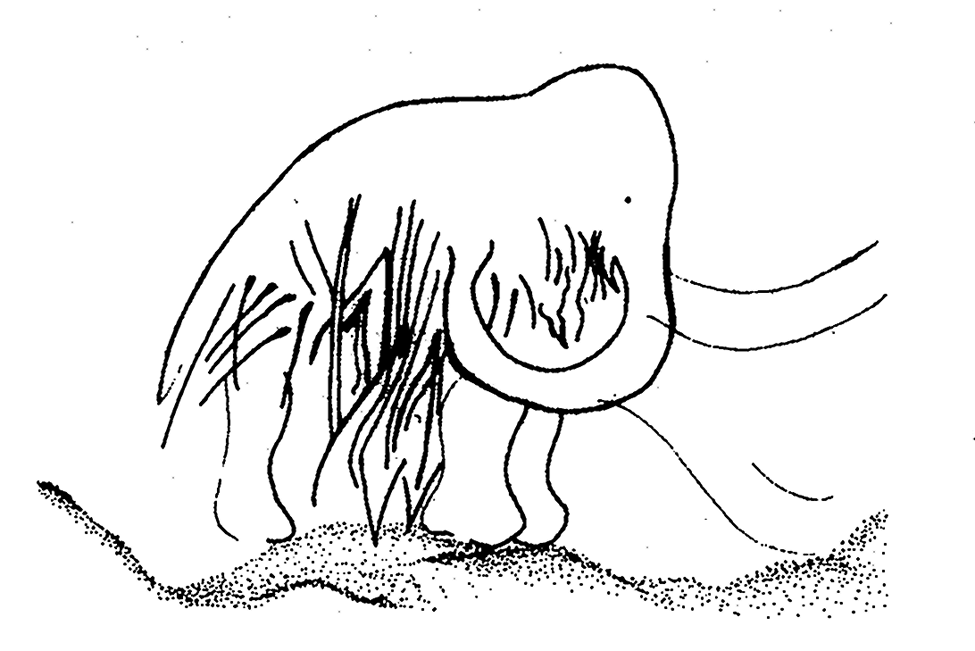
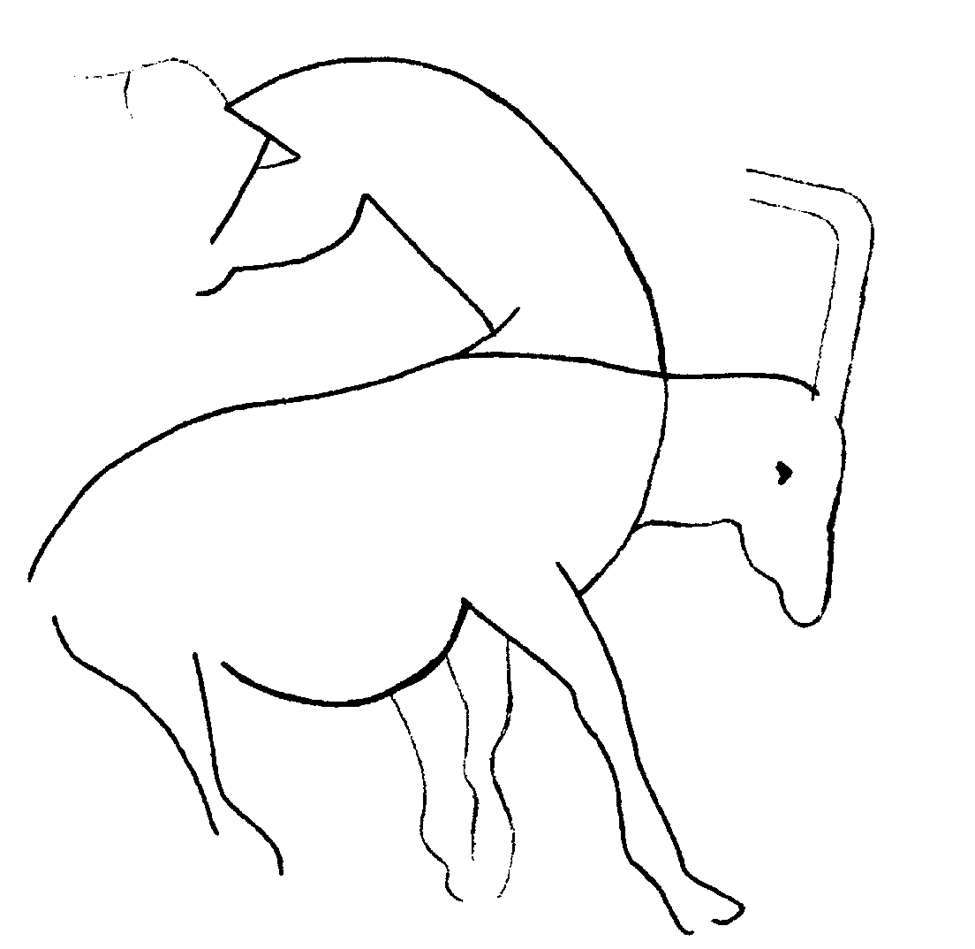
It seems to be the case that humans have been producing little dancing images for as long as we have been producing art. It might just be the at the animated gif, the blinky, the flicker, and the dancing firelight figures are a fundamental part of human nature. We have always made them and it looks like we will never stop.